
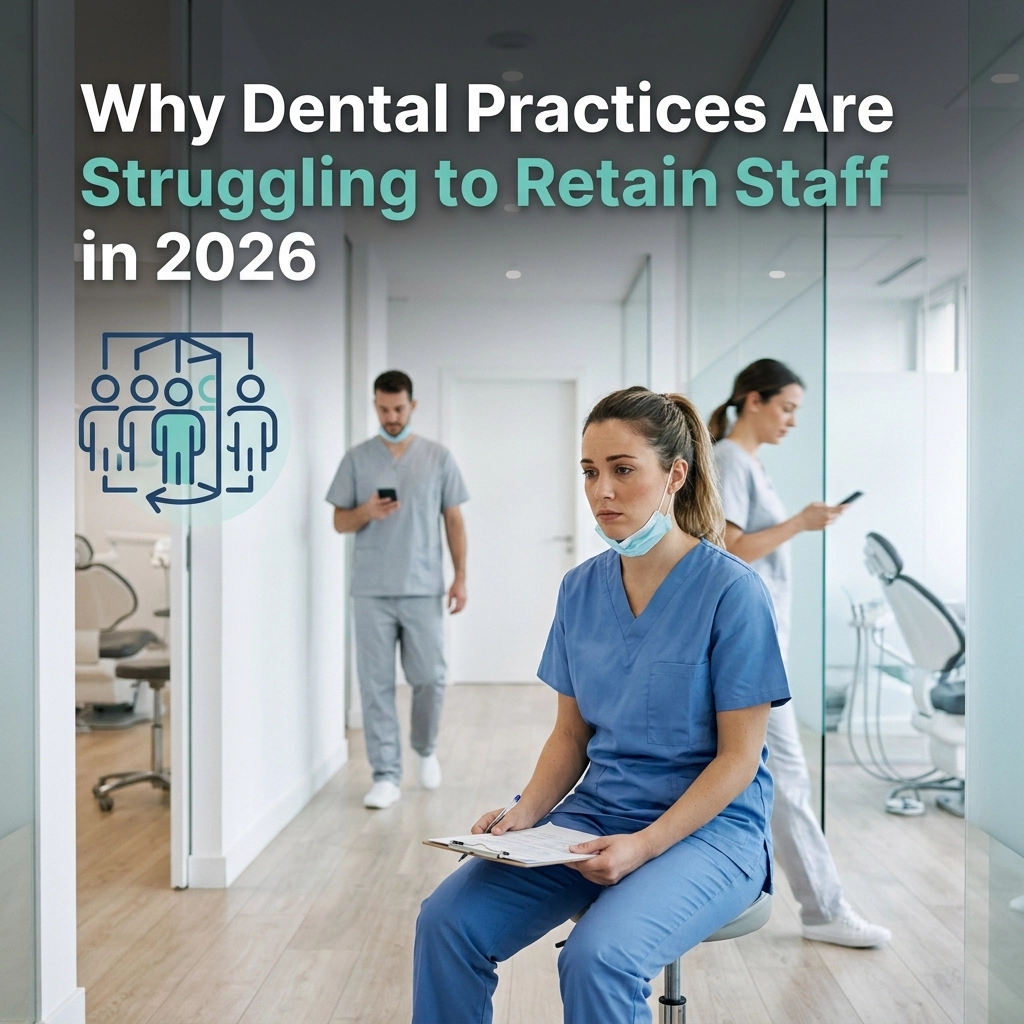
Why Dental Practices Are Struggling to Retain Staff in 2026
![[HERO] Why Dental Practices Are Struggling to Retain Staff in 2026](https://cdn.marblism.com/kyN2_z1_-B4.webp)
At Dental Recruit Network ltd, we’ve seen the landscape of UK dentistry shift more in the last two years than in the previous decade. As we navigate through 2026, the conversation in staff rooms across the country has changed. It’s no longer just about "getting through the day"; it’s about whether the day is worth the effort.
If you are running a practice, you’ve likely felt the sting of a high-performer handing in their notice seemingly out of the blue. You’re not alone. The "Great Dental Resignation" of the mid-2020s hasn’t slowed down; it has evolved. While many blame a "shortage of candidates," the reality is often closer to home. The struggle to retain staff in 2026 is a complex cocktail of stagnant wages, operational burnout, and a fundamental shift in what dental professionals expect from their workplace.
The Burnout Factor: More Than Just a Bad Day
In 2026, clinical burnout is the single biggest threat to practice stability. We are seeing dental nurses and hygienists leaving the profession entirely: not just moving to the practice down the road. The pressure to hit targets, manage complex patient needs, and maintain rigorous compliance standards has reached a boiling point.
When your team is constantly operating in "survival mode," mistake rates climb and morale plummets. Staffing pressure isn't just about being one person down; it’s about the cumulative weight on the remaining team members who have to pick up the slack. If your staff feels like they are on a treadmill that only goes faster, they will eventually jump off.

The Salary Reality Check: Is Your Pay Scale Stuck in 2023?
Let’s talk about the elephant in the room: dental nurse pay UK averages. We frequently speak with talented professionals who love their patients but simply cannot afford to stay in their roles. In 2026, the cost of living has made "competitive" salaries of three years ago completely obsolete.
If you haven't reviewed your dental nursing salary UK benchmarks recently, you are likely falling behind. We are seeing a significant gap between practices that view nursing as an entry-level cost and those that view it as a professional investment.
Currently, the average dental nurse uk salary has seen a necessary upward trend to keep pace with inflation and the rising demand for skilled clinical support. Practices that attempt to "save" on payroll are finding that the cost of recruitment, onboarding, and lost production far outweighs the cost of a fair pay rise. Candidates are savvy; they know their worth, and they are using our jobs board to benchmark their expectations daily.
The NHS vs. Private Workload Tension
The divide between NHS and private dentistry has never been more pronounced than it is in 2026. Staff working in high-volume NHS environments often report feeling like they are on a conveyor belt. The sheer volume of patients, combined with administrative hurdles, creates a high-stress environment that is difficult to sustain long-term.
Conversely, private practices offer a different pace but come with higher patient expectations. When staff are caught in the middle: perhaps in a mixed practice: the cognitive load of switching between these two "modes" of care can be exhausting. Many dental nurses are moving toward private-only roles or transitioning into specialized positions like a treatment coordinator to escape the frantic pace of general NHS nursing.
Why Good Staff "Quietly" Leave
One of the most frustrating things for a practice owner is the "silent exit." This is when a reliable, high-performing staff member suddenly resigns without ever having complained. Why does this happen?
- Lack of Growth: They feel they’ve hit a ceiling. If there is no path to becoming a Lead Nurse, Practice Manager, or treatment coordinator, they will look for that growth elsewhere.
- Unaddressed "Micro-Frustrations": The broken autoclave that never gets fixed, the late-running clinics that consistently eat into lunch breaks, or the lack of basic recognition.
- The "Nurse Tax": This is the feeling that they are expected to do "everything" (decontamination, reception, clinical, cleaning) without the compensation or title to match.
If you aren't actively discussing career pathways with your team, they will assume there aren't any. We encourage employers to look at our insights page to see how career mapping can transform retention.

The New Frontier: Flexibility and Work-Life Balance
In 2026, flexibility is no longer a "perk": it is a requirement. The traditional 8:00 to 6:00, five-day-a-week model is struggling to attract the modern workforce.
We are seeing a massive surge in dental professionals seeking:
- Four-day work weeks (compressed hours).
- Job sharing opportunities.
- Hybrid roles for administrative or TCO tasks that can be done partially from home.
Practices that refuse to budge on rigid scheduling are losing their best people to more forward-thinking clinics. Even small concessions, like guaranteed finish times or flexible start times for parents, can make a world of difference in your retention rates.
How to Turn the Tide: Improving Retention in 2026
If you want to stop the revolving door of recruitment, you need a proactive strategy. It’s about more than just a Christmas party; it’s about the daily culture.
1. Conduct a "Stay Interview"
Don't wait for the exit interview to find out what's wrong. Ask your team now: “What keeps you here, and what’s one thing that would make you want to leave?” You might be surprised how often the answer is something easily fixable.
2. Invest in the Treatment Coordinator (TCO) Role
The treatment coordinator is a vital bridge between the clinical team and the patient. By promoting from within or hiring a dedicated TCO, you alleviate the pressure on your dentists and nurses, while providing a clear career ladder for your ambitious staff. You can find more about these specialized roles on our sectors page.
3. Review Your Compensation Regularly
Ensure your dental nurse pay UK rates are not just "market average" but "market-leading" if you want to keep the best talent. Performance-based bonuses or loyalty increments can also go a long way in showing your team they are valued.
4. Foster a "Culture of Appreciation"
Publicly acknowledge wins. Whether it’s a great patient review or a smooth CQC inspection, make sure the team knows their hard work didn't go unnoticed. A culture of gratitude is much harder to walk away from than a culture of "just getting the job done."

The ROI of Retention
The cost of replacing a dental nurse in 2026: including agency fees, lost clinical time, and training: can easily exceed £5,000 to £8,000. When you multiply that by a high turnover rate, the financial impact on a practice is devastating.
By focusing on your internal culture and meeting the modern expectations for flexibility and pay, you aren't just being a "nice" employer; you are making a savvy business decision.
If you’re struggling to find the right balance or need help sourcing high-quality candidates who are looking for a long-term home, contact us today. At Dental Recruit Network ltd, we don't just fill vacancies; we help build stable, thriving dental teams.
Ready to grow your team?
The landscape of 2026 is challenging, but for practices that prioritize their people, it’s also an era of incredible opportunity. Let’s make your practice the one that people are queuing up to join, not the one they can’t wait to leave.