
Dental Recruit Network
GDC register search: how to check a dental professional is registered
A practical guide to the General Dental Council register for practice managers, principals and dental professionals: how to search it, what each entry tells you, and what it doesn’t.
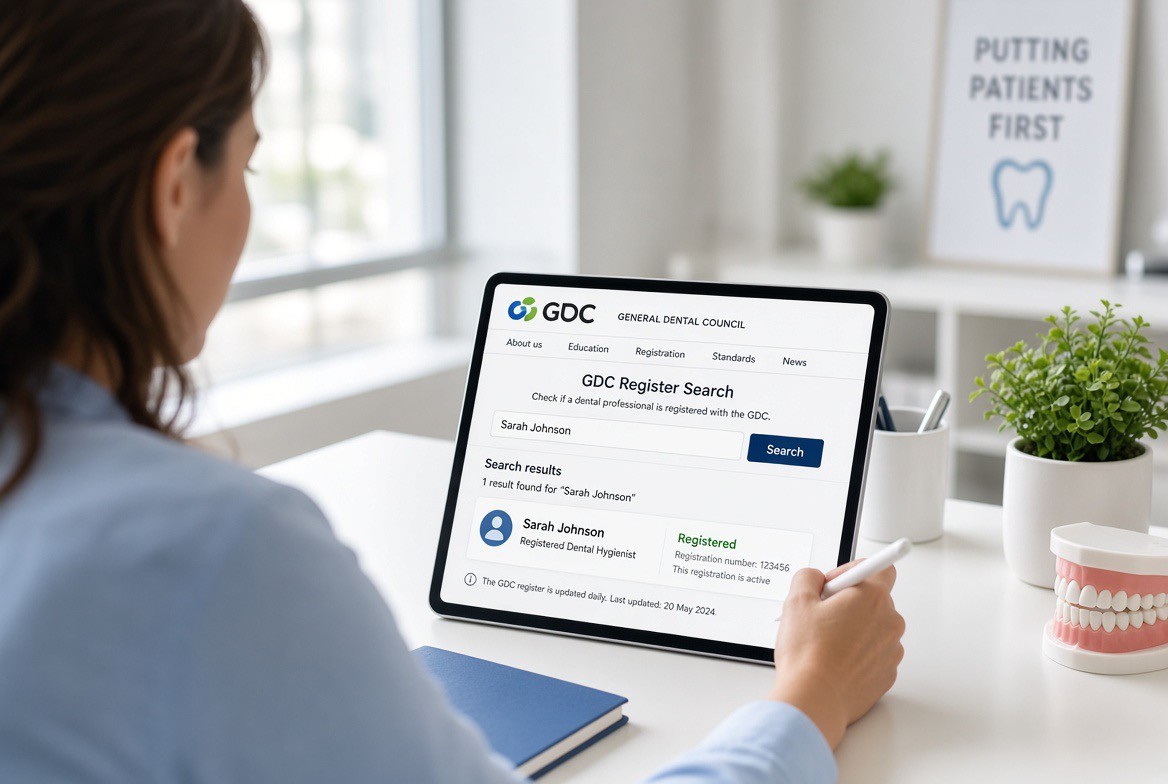
Illustrative example only, not a real registrant.
Every dentist, dental nurse, dental hygienist, dental therapist, dental technician, clinical dental technician and orthodontic therapist working in the UK must be registered with the General Dental Council (GDC). The GDC register is the public record of who those people are, and it’s free for anyone to search.
For practices, a GDC register search is the first check you should run before anyone treats a patient, whether they’re a new associate, a permanent nurse or a locum covering a single day. Here’s how it works.
What is the General Dental Council?
The General Dental Council is the UK-wide statutory regulator for the dental team. Set up under the Dentists Act 1984, the GDC’s job is to protect patients by:
- keeping the register of qualified dental professionals
- setting the standards of practice and conduct registrants must meet
- setting requirements for continuing professional development (CPD)
- investigating concerns about a registrant’s fitness to practise
- taking action against people who practise dentistry illegally
Because the GDC regulates individuals rather than practices, it sits alongside, not instead of, the Care Quality Commission (CQC) in England and its equivalents in Scotland, Wales and Northern Ireland, which regulate the practice itself.
What is the GDC register?
The GDC online register is a live, searchable list of everyone legally allowed to work in UK dentistry. It’s made up of several parts:
| Register | Who’s on it |
|---|---|
| Dentists Register | All registered dentists, including associates and practice owners |
| Dental Care Professionals (DCP) Register | Dental nurses, hygienists, therapists, dental technicians, clinical dental technicians and orthodontic therapists |
| Specialist Lists | Dentists entitled to use a specialist title, such as orthodontist, endodontist or oral surgeon |
| Temporary Registrant Dentists | Dentists with an overseas qualification registered for a limited period to train, teach or research in approved posts |
| Visiting Practitioners | Eligible practitioners providing services in the UK on a temporary and occasional basis |
The GDC updates the online register daily, so a search reflects someone’s current position rather than a snapshot from months ago.
How to search the GDC register
You’ll find the search tool on the GDC website at gdc-uk.org (the online register itself sits at olr.gdc-uk.org). There’s no login and no charge.
- Open the register search on the General Dental Council website.
- Choose how to search: by registration number, or by name with an optional town to narrow results.
- Pick the register from the dropdown: all registers, dentists, DCPs, specialist lists, temporary registrants or visiting practitioners.
- Open the individual record and check the registrant type, status and current registration period.
- Match it to the person in front of you. Compare the name and number against their ID and CV. If you can’t find them, try spelling variations and remove the town before drawing conclusions.
The registration number is always the better search. Common surnames can return dozens of results, and people may be registered under a previous or maiden name.
What a GDC register entry tells you
Each individual record shows the registration number, registrant type, current status, the date they were first registered, their current registration period and the qualification that led to registration. Dentists on a specialist list will also show the specialism.
The register also shows current fitness to practise outcomes, such as conditions on someone’s practice or a suspension. If a registrant has conditions, read them carefully: they can restrict the work someone may do or require supervision, which directly affects whether a role is suitable.
A clean register entry means someone is entitled to practise. It doesn’t mean every pre-employment check is done.
What the GDC register doesn’t cover
The register confirms
- They’re registered right now
- Their registered title
- Any specialist listing
- Current conditions or suspension
You still need to check
- Identity and right to work
- DBS check
- Indemnity cover
- Immunisation, including hepatitis B
- References and employment history
- CPD and training records
In England, CQC Regulation 19 (fit and proper persons employed) requires practices to have robust recruitment checks for everyone they engage, including locums and agency staff. A GDC register search is one part of that evidence, not the whole of it.
GDC registration deadlines to know
To stay on the register, every registrant pays an annual retention fee (ARF) and declares CPD. Miss the deadline and they can be removed from the register, at which point they can’t legally work until they’re restored.
| Registrant group | Annual renewal deadline |
|---|---|
| Dentists | 31 December |
| Dental care professionals | 31 July |
CPD runs in five-year cycles, with a declaration due each year. Since March 2026, registrants manage their renewal, fees and CPD declarations through MyGDC, the GDC’s new online portal that replaced eGDC.
For practices, the practical point is simple: re-check the register for your team shortly after each renewal deadline. It takes minutes and avoids the risk of someone working while unregistered.
Why practices should check before every booking
It’s easy to check a permanent hire once and forget about it, but registration status can change. Conditions can be imposed, a suspension can follow an investigation, and registration can lapse over an unpaid fee. For locum cover, where you might see a professional for the first time on the morning of the session, the check matters even more.
That’s why at Dental Recruit Network we check GDC registration as part of our compliance process before placing any dental nurse, hygienist, therapist or dentist with a practice, alongside the wider checks your CQC inspector will expect to see.
GDC register: frequently asked questions
Is the GDC register search free?
Yes. The General Dental Council register is a public record. Anyone, including patients, practices and employers, can search it free of charge without creating an account.
Do dental nurses need to be on the GDC register?
Yes. Qualified dental nurses must be registered with the GDC to work in the UK. Trainee dental nurses can work while enrolled on a GDC-recognised training programme, provided they’re appropriately supervised.
How often is the GDC register updated?
The GDC updates its online register daily, so it reflects a registrant’s current status.
Can I search the GDC register by registration number?
Yes. Searching by GDC number is the quickest and most accurate method, as it returns a single individual. You can also search by name and town.
What’s the difference between the GDC and the CQC?
The GDC regulates individual dental professionals. The CQC regulates dental practices in England as service providers. A thorough check looks at both: the professional on the GDC register and the practice on the CQC register.
What happens if someone isn’t on the GDC register?
If you can’t find someone after trying spelling variations and their registration number, they shouldn’t carry out any dental work that requires registration. Ask them for proof and, if you have concerns, raise them with the GDC.
Need cover you can trust?
Dental Recruit Network supplies GDC-registered dental nurses, hygienists, therapists and associates to practices across the UK, for locum shifts and permanent roles.
Find dental staff with DRN