British Dental Journal (BDJ): A Guide for UK Dental Teams
Plus the other dental magazines and journals for dentistry worth your time
Keeping up with clinical developments is part of the job for every dentist, hygienist, therapist and dental nurse. With so many dental magazines and journals competing for your attention, it helps to know which ones are worth reading. At the top of most UK reading lists sits the British Dental Journal, better known as the BDJ.
This guide covers what the BDJ is, what you’ll find in it, how to access it, and which other journals for dentistry deserve a place in your routine.
What is the British Dental Journal?
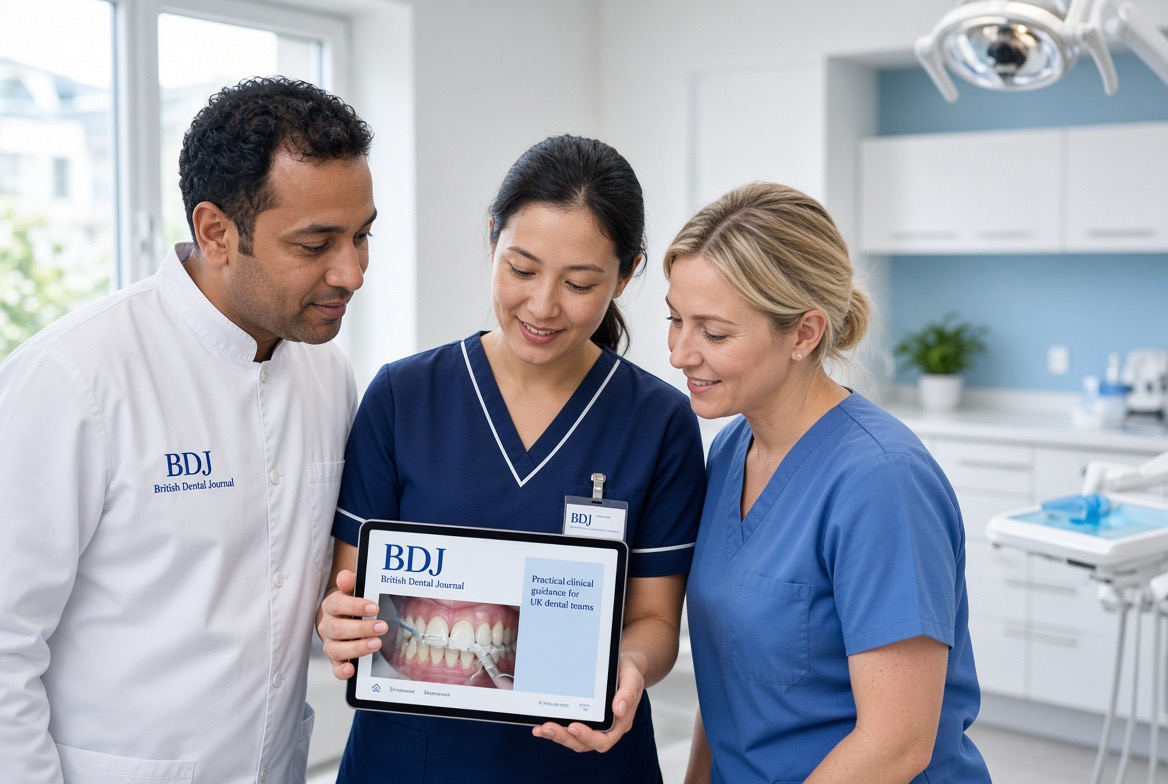
The British Dental Journal is the official journal of the British Dental Association (BDA). It’s an international, peer-reviewed publication produced by Springer Nature on behalf of the BDA, and it’s one of the longest-running dental titles in the world.
Its stated aim is to inform readers about ideas, opinions, developments and key issues in dentistry, across clinical, practical and scientific topics, and to spark debate among dentists of every discipline. In practice, that means it reads less like a dry academic journal and more like the profession’s shared noticeboard: research sits alongside news, opinion and letters.
What’s inside the BDJ?
Each issue mixes several types of content, which is a big part of its appeal:
- Research articles – original, peer-reviewed studies, many published open access.
- Clinical articles – practical pieces aimed at general practitioners, such as recent work on tissue-level implants in the aesthetic zone and osteoradionecrosis updates for GDPs.
- Reviews and analysis – narrative reviews and perspectives on emerging topics, from oral microbiome research to AI and ambient voice technology in clinical records.
- News and comment – guidance updates (for example, recent NHS England and DHSC changes to infective endocarditis advice), BDA news and professional developments.
- Letters and opinion – lively debate between clinicians on contested topics.
- Product news – updates from dental manufacturers and suppliers.
The BDJ also runs themed Collections, currently including sustainable dentistry and clinical guidelines, which are useful if you want to read deeply on one subject.
How to access the BDJ
There are three main routes:
- BDA membership – the BDJ is included as a membership benefit, alongside CPD and practice support.
- Subscription – individuals and institutions can subscribe directly through Springer Nature.
- Open access articles – a growing share of research is free to read for everyone, so it’s worth browsing even without a subscription.
You can also sign up for email alerts or follow the RSS feed to see new articles as they’re published.
BDJ and CPD
For many registrants, the BDJ’s biggest practical value is verifiable CPD. Reading selected articles and completing the linked questions can contribute towards your GDC CPD requirements, which makes it an efficient way to stay current and stay compliant at the same time. Check the BDJ CPD page for what’s currently available and how to log it.
The wider BDJ Portfolio
The BDJ sits within a family of titles, each aimed at a different audience:
- BDJ Team – written for dental nurses, hygienists, therapists, technicians and practice managers.
- BDJ In Practice – business and practice management for owners and principals.
- BDJ Open – a fully open access research journal.
- Evidence-Based Dentistry – summaries and critical appraisals of key research.
If you’re a dental care professional rather than a dentist, BDJ Team is often the most relevant starting point.
Other dental magazines and journals for dentistry
The BDJ isn’t the only option. Depending on your role and interests, these are well worth knowing:
- Dental Update – a long-established UK monthly with a strong clinical CPD focus, popular with GDPs.
- Primary Dental Journal – published by the College of General Dentistry, focused on general practice.
- Journal of Dentistry – an international, research-led journal from Elsevier.
- International Dental Journal – the journal of the FDI World Dental Federation, with a global public health angle.
- Dentistry and Private Dentistry – UK trade magazines covering clinical tips, business and industry news.
- Dental Health – the journal of the British Society of Dental Hygiene and Therapy (BSDHT), aimed at hygienists and therapists.
A sensible mix: one peer-reviewed journal for evidence, one clinical CPD title for technique, and one trade magazine for industry news.
Making reading part of your week
Busy surgery lists make it easy to let journals pile up. A few habits help:
- Set up email alerts for the subjects you care about rather than reading every issue cover to cover.
- Block 30 minutes a week for reading and log any verifiable CPD straight away.
- Use themed collections when you’re preparing for a new skill or service.
- Share useful articles with your team at practice meetings.
Reading for your next career move
Staying current doesn’t just improve patient care – it’s also one of the clearest signals of commitment when you’re looking for a new role. Practices notice candidates who can talk confidently about recent guidance and evidence.
If you’re a dentist, hygienist, therapist or dental nurse considering your next locum or permanent position, Dental Recruit Network works with practices across the UK to find roles that fit your skills and ambitions.
Talk to our teamFrequently asked questions
What does BDJ stand for?
BDJ stands for British Dental Journal, the official journal of the British Dental Association.
Is the British Dental Journal free?
Some BDJ research is published open access and free to read. Full access comes with BDA membership or a paid subscription.
Who publishes the BDJ?
The BDJ is published by Springer Nature on behalf of the British Dental Association.
Can I get CPD from the BDJ?
Yes. The BDJ offers verifiable CPD linked to selected articles, which can count towards GDC requirements.
What are the best journals for dentistry in the UK?
Popular choices include the British Dental Journal, Dental Update, Primary Dental Journal, BDJ Team (for dental care professionals) and Dental Health (for hygienists and therapists).